
Every explanation of MCP you will read starts with the same sentence: it is a USB-C port for AI. That analogy comes from the official docs, and it is fine as far as it goes — but it tells you what MCP is like rather than what an MCP server actually does when your agent calls one.
Quick answer: An MCP server is a small program that exposes three things to an AI client over JSON-RPC: tools (functions the model can call), resources (read-only data it can pull in), and prompts (reusable templates). The client — Claude, Cursor, ChatGPT — decides when to call them. Write the server once, and every MCP-compatible AI app can use it.
Key takeaways
Three capabilities, one protocol. Tools, resources and prompts. Everything an MCP server offers falls into one of those three buckets, and that is most of what the spec is.
The model decides, not your code. This is the real difference from an API. You expose a capability and describe it; the model picks the moment to use it.
"Server" usually means a local subprocess. Most MCP servers are not hosted anywhere — your AI client launches them on your machine and talks over stdio. Remote HTTP servers exist and are growing.
The ecosystem is bigger than the official list. Anthropic's repo ships 7 reference servers; public directories index more than 9,800.
What is an MCP server, exactly?
The Model Context Protocol is an open standard, published by Anthropic in November 2024 and now maintained as an open-source project, for connecting AI applications to external systems. An MCP server is one half of that connection: a program that advertises what it can do, then waits.
Concretely, a server speaks JSON-RPC and exposes up to three kinds of thing:
- Tools — functions the model can execute. Query a database, open a pull request, search a dataset, send a message. Each has a name, a description, and a typed input schema.
- Resources — read-only data the client can pull into context. Files, records, documents. No side effects.
- Prompts — reusable templates that shape how the server is meant to be used.
Three parts make up the whole picture, and the naming trips people up:
What is the difference between an API and an MCP server?
An API is called by code you wrote. An MCP server is called by the model.
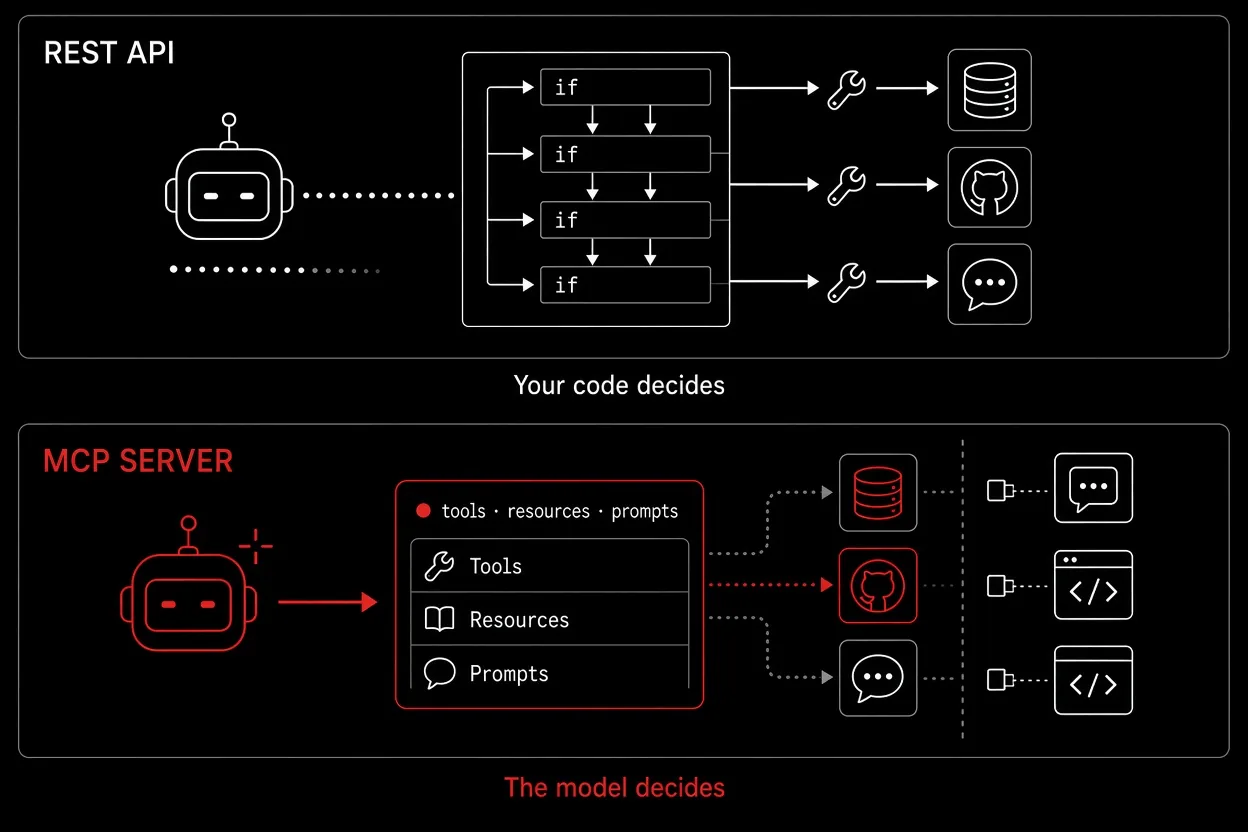
REST API: your code decides. MCP server: the model decides. Same backends (database, GitHub, chat), different place for the logic.
That is the whole distinction, and it changes what you have to build. With a REST API, you write the integration: decide which endpoint to hit, when to hit it, how to parse the response, and what to do with the result. The intelligence lives in your code.
With MCP, you describe the capability — a name, a sentence of description, an input schema — and the model works out when it is useful. Nobody writes an if-statement that says "if the user mentions a pull request, call the GitHub API." The model reads the tool description and decides.
The practical consequences:
One integration, every client. An MCP server works in Claude, Cursor, and any other MCP host without a per-app SDK.
Descriptions are the interface. A badly described tool goes uncalled. Tool descriptions are prompt engineering, not documentation.
Most MCP servers wrap an API. The GitHub MCP server calls GitHub’s REST API underneath. MCP is a layer on top of APIs, not a replacement for them.
Is an MCP server a real server?
Usually not in the way you are picturing. Most MCP servers run locally as a subprocess: your AI client launches the program on your own machine and talks to it over stdio. Nothing is deployed, nothing listens on a port, and no traffic leaves your computer unless the server itself makes an outbound call.
The word "server" is right in the client-server sense, not the "rack in a data centre" sense.
There is a second kind. Remote MCP servers are hosted HTTP endpoints you connect to by URL, and they are growing quickly because they need no installation and can hold credentials centrally. GitHub runs one at api.githubcopilot.com/mcp/. Prowlo runs one at api.prowlo.com/mcp. For a remote server you paste a URL and a key; for a local one you install a package and point your config at it.
Can you give me an example of an MCP server?
Anthropic's reference implementations are the clearest starting point — the repo has 86,700 stars and now ships seven of them: Everything, Fetch, Filesystem, Git, Memory, Sequential Thinking, and Time. Filesystem is the one most people meet first: it gives the model read and write access to directories you nominate, and nothing else.
Beyond those, the servers you are most likely to connect are maintained by the companies whose product they wrap — GitHub's own server has 32,200 stars, and Sentry, Notion, Cloudflare, Figma and Stripe all publish their own. We keep a running list of which MCP servers are official, archived, or worth using.
A worked example of what a server call looks like in practice: Prowlo is an MCP server for Reddit and X data. Your agent calls search_dataset with a natural-language query, and gets back typed JSON records ranked by meaning. The model decided to call it; you never wrote a line of Reddit integration code. That is the shape of every MCP interaction.
Does ChatGPT use MCP?
Yes. OpenAI adopted MCP in 2025, and ChatGPT supports MCP servers through connectors and its developer mode, as do Claude, Cursor, Cline, Zed, Windsurf and a growing list of others. That cross-vendor adoption is the reason MCP matters: a server you write once is not locked to one AI company's ecosystem, which was the whole problem the protocol set out to fix.
Why use MCP instead of just calling an API?
If you are writing deterministic code with a known sequence of steps, use the API. MCP earns its place when you do not know the sequence in advance — when the useful thing is letting a model choose which capability to reach for, in what order, based on what a person just asked.
The second reason is distribution. Wrapping your product in an MCP server means every MCP-compatible AI application can use it immediately, without you shipping an integration for each one. For a small team that is a meaningful difference in reach per unit of work.
How do you connect an MCP server to Claude or Cursor?
For a local server, add an entry to your client's config file naming the command to run:
{
  "mcpServers": {
    "filesystem": {
      "command": "npx",
      "args": ["-y", "@modelcontextprotocol/server-filesystem", "/Users/you/projects"]
    }
  }
}
For a remote server, point at the URL and supply a key instead. Restart the client and the tools appear. Our MCP setup guide covers both paths in detail, and the Claude, Cursor & Cline integration page has per-client config.
Related reading
- The MCP server list: what's official, what's archived
- The best Reddit MCP servers in 2026, compared
- Prowlo's Reddit MCP server
- Connect Claude, Claude Code, Cursor & Cline
FAQ
What does MCP stand for? Model Context Protocol. It is an open standard, published by Anthropic in November 2024 and now maintained as an open-source project, for connecting AI applications to external tools and data. "MCP server" is the program on the far end of that connection.
What is the difference between MCP and an MCP server? MCP is the protocol — the specification for how AI clients and external programs talk. An MCP server is one program that implements it. Saying "an MCP" when you mean a server is common but imprecise, roughly like calling a website "an HTTP."
Is MCP the same as RAG? No. RAG is a technique for retrieving documents and stuffing them into a prompt before the model runs. MCP is a protocol that lets the model call tools and fetch resources while it runs. An MCP server can serve a RAG pipeline, but they solve different problems.
Do I need to build my own MCP server? Only if you are exposing something nobody has wrapped yet. Public directories index more than 9,800 servers, so check there first. If you do build one, Anthropic publishes SDKs for Python and TypeScript.
Are MCP servers safe? A local MCP server runs with your permissions and can do whatever its tools allow, so install servers the way you install any dependency: check who maintains it, prefer official and vendor-published ones, and give filesystem servers the narrowest directory that works. Read-only servers carry the least risk.
Want a worked example you can call today? Prowlo is a hosted MCP server for Reddit and X — your agent searches a filtered, semantically indexed Dataset over MCP, with no API keys to manage. Start a free 14-day trial →