
ChatGPT Pulse launched in September 2025 with the strongest proactive-AI marketing ever written. Nine months later, OpenAI quietly retired it. That arc is the most useful datapoint anyone building or buying "AI that works while you sleep" has gotten so far — because what killed Pulse and what survived it draw a precise line between proactive AI that works and proactive AI that becomes homework.
What happened to ChatGPT Pulse?
ChatGPT Pulse is discontinued. OpenAI announced its retirement on June 17, 2026, about nine months after launch. The proactive daily feed is gone; its useful parts were folded into scheduled tasks and web-monitoring tasks that users configure explicitly. Pulse's cards no longer generate, and OpenAI has framed the replacement as giving users direct control over what gets checked and when.
What was ChatGPT Pulse?
Pulse was a proactive feed: ChatGPT did asynchronous research overnight — based on your chat history, memory, and connected apps like calendar and email — and greeted you each morning with a set of visual cards. You steered it with thumbs up/down and topic requests, and the next night's run consumed the feedback.
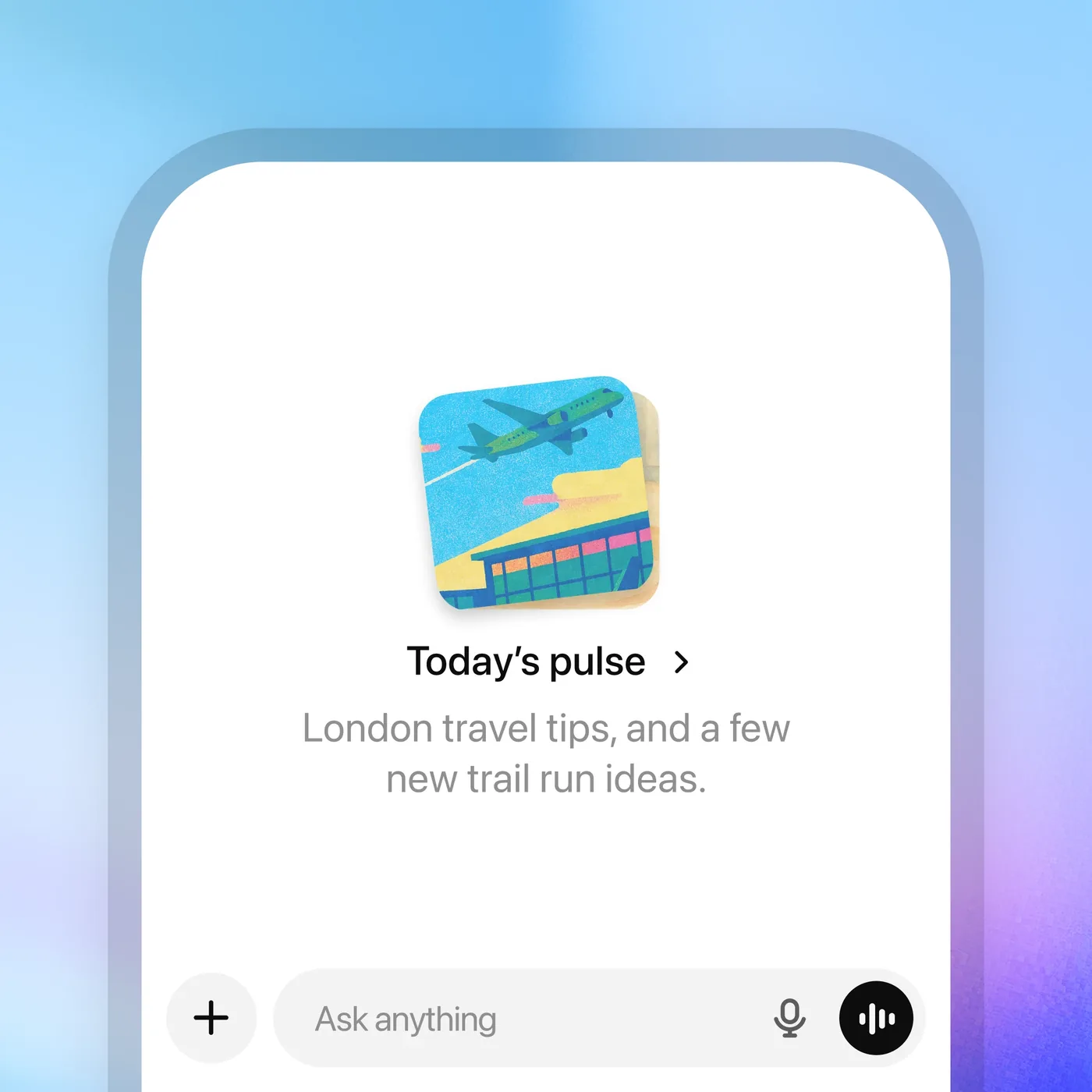
The "Today's pulse" card sat at the top of the ChatGPT mobile app each morning — one tap opened the full deck of briefing cards the model had assembled overnight.
The launch framing was maximal. OpenAI's announcement declared "Now ChatGPT can start the conversation" and argued that chat "puts the burden on you." Sam Altman: "Pulse works for you overnight... Every morning, you get a custom-generated set of stuff you might be interested in" — he called it his favorite ChatGPT feature. Fidji Simo said it brought "the level of support that only the wealthiest have been able to afford" to everyone.
It was also expensive to run: at launch Pulse was exclusive to the $200/mo Pro tier on mobile, with a web rollout following in October 2025 and no free-tier availability at any point.
The nine-month timeline
The search curve tells the adoption story on its own: 33,100 monthly Google searches for "chatgpt pulse" at peak (September 2025, per Google Ads data), down to roughly 1,300 by May 2026 — a 96% decline before OpenAI pulled the plug.
Why did ChatGPT Pulse fail?
Not for lack of distribution, budget, or model quality. Three failure modes did the damage, and all three are instructive.
Relevance decayed instead of compounding. Pulse inferred what you cared about from chat history — and kept inferring it long after you'd moved on. The developer banteg, a Pro subscriber, put it bluntly a week before the shutdown: "it still latches onto questions i have resolved weeks ago and presents them as if my life depended on them. stop wasting compute on it and shut it down." Former Pulse users made the same structural point more politely: mixing personal chats, calendar, and research interests into one feed produced briefings that were confidently about the wrong things.
"When to speak up" is an unsolved research problem. The academic results here are humbling. ProAgentBench (Feb 2026), built from 28,500 events across 500+ hours of real computer activity, found the best model hits just 64.4% accuracy on deciding whether an agent should proactively assist. An earlier Tsinghua paper trained a reward model that agrees with humans about when help is wanted at 91.8% — but fine-tuned models still only got it right ~66% of the time. A proactive product that's wrong a third of the time doesn't feel prescient; it feels like spam you can't unsubscribe from.
A feed without an action attached becomes homework. Pulse delivered things to read. It didn't triage, didn't draft, didn't hand anything to a workflow. That made it one more inbox — and there's real evidence users prefer fewer, batched interruptions: a 2019 randomized trial found batching notifications ~3×/day beat both instant delivery and full suppression for well-being. Reading a daily AI magazine about your own life, it turns out, is a chore.
What survived: standing tasks with deliverables
The revealing part isn't that Pulse died — it's what OpenAI kept. Scheduled tasks (a stored prompt that runs on your schedule, capped at 10 active tasks) and web-monitoring tasks survived and got promoted. The same shape won everywhere else in 2025–2026:
- Gemini Scheduled Actions — "wake up with a summary of your calendar and unread emails," configured explicitly by the user
- Perplexity Tasks — background monitoring that "notifies you only when results are noteworthy; routine checks with no new findings remain silent"
- Claude scheduled tasks — cloud-run agent sessions on a cadence, with tools and deliverables
- ChatGPT scheduled tasks + web monitoring — Pulse's official successor
The pattern that survived, stated once: the user defines a standing query; the system checks quietly; something arrives only when there's signal; and what arrives is a deliverable or a trigger, not a card to admire. The passive inferred feed died. The explicit task with an output lived. This is the core distinction inside the whole ambient agents wave, and Pulse is now its canonical case study.
What this means if you're building (or buying) proactive AI
Three tests, straight from the post-mortem. Does the system know what it's watching because you told it, or because it guessed from your history? Guessing is how you get cards about a trip you took last month. Does silence count as success? A proactive product that must produce a daily artifact will pad it; one that can say "nothing today" earns trust. And when it does speak, does something happen — a draft, a webhook, a task for your review — or do you just get reading material?
Disclosure, since we're obviously not neutral: Prowlo is our product, and it's built on the surviving pattern rather than the dead one. You create Watchers on specific subreddits and X accounts (explicit, not inferred), they fill a Dataset your agent searches over MCP, and Alerts fire a webhook into your agent only when new records match a standing query. Prowlo finds and filters; your agent reasons and drafts; you post. No feed, no cards, no guessing.
There's one gap Pulse's official successor can't close, though. ChatGPT's web-monitoring tasks watch the open web — and Reddit blocks every crawler except Google's, while X charges per read. If the conversations you need to watch happen on social platforms — and for most B2B niches, that's where buyers deliberate — the scheduled task needs a data layer with its own compliant access. That's the lane we build for, and the practical build is a ten-minute setup: a Claude scheduled task that briefs you on your market every morning.
FAQ
Is ChatGPT Pulse coming back? There's no indication it will. OpenAI retired Pulse in June 2026 and moved its functionality into scheduled tasks and web-monitoring tasks, which give users explicit control. A future proactive feed isn't ruled out, but the company's stated direction is user-configured tasks, not inferred briefings.
What replaced ChatGPT Pulse? Scheduled tasks and web monitoring inside ChatGPT: you write a prompt, set a cadence, and receive results by push or email. Up to 10 tasks can be active. The difference from Pulse: you define what gets checked, instead of the model inferring it from your chat history.
Was ChatGPT Pulse free? No. Pulse launched September 25, 2025 as an exclusive for the $200/month Pro plan on mobile, expanded to the web in October, and was never released to free or Plus tiers before retirement in June 2026.
How do I get a Pulse-style morning brief now? Use a scheduled task pointed at an explicit data source. For general news and email, ChatGPT scheduled tasks or Gemini Scheduled Actions cover it. For your market on Reddit and X — which platform agents can't crawl — a Claude scheduled task reading a Prowlo Dataset produces a morning brief with threads worth acting on.
Why did OpenAI kill Pulse? OpenAI framed it as consolidation into scheduled tasks. The observable reasons: relevance complaints (cards about stale topics), a hard open problem in deciding when proactive help is wanted (best published accuracy: ~64%), and a format — reading cards — that produced no action. The explicit-task model replaced the inferred-feed model.